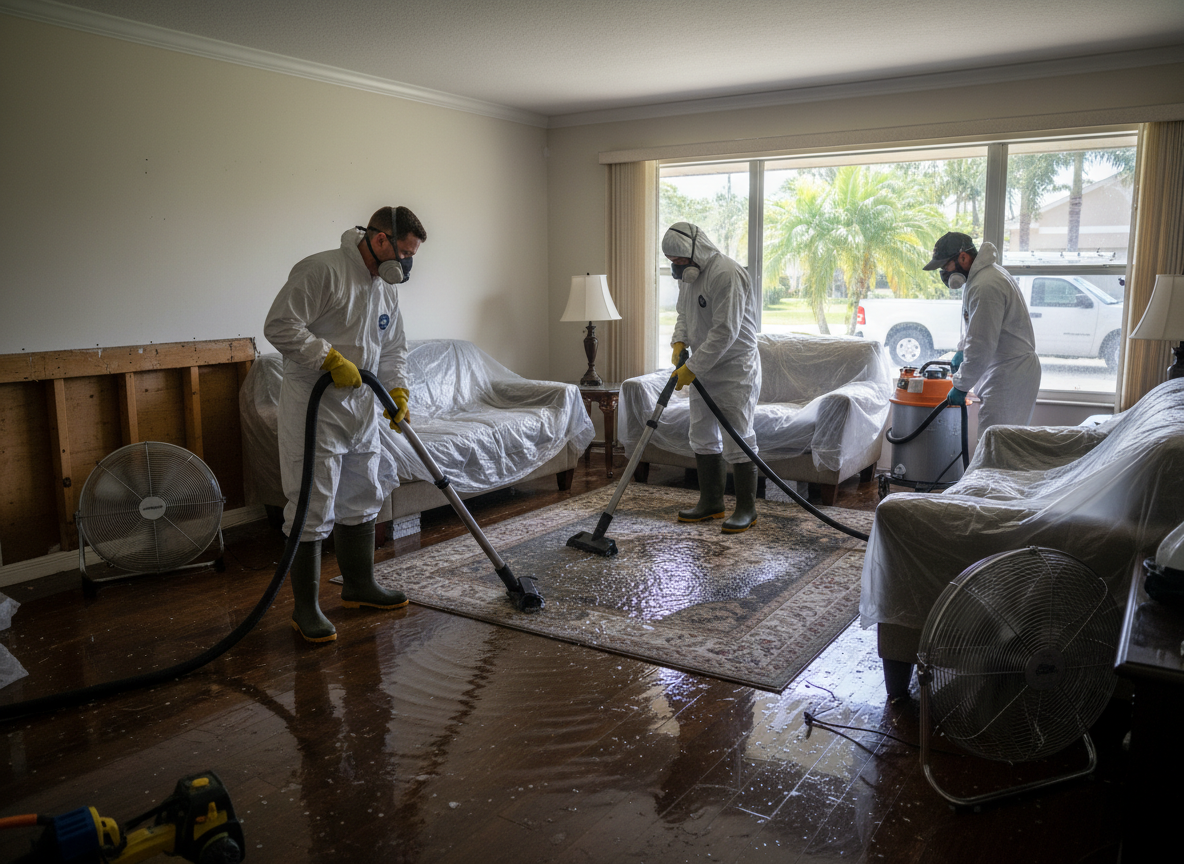
Greenacres is an incorporated city of about 43,990 people across roughly six square miles in Palm Beach County, sitting at about 16 feet above sea level. Its housing runs from older single-family streets to villas, townhomes and apartment communities, and that mix changes how a water loss behaves. This page explains what we look for at a Greenacres address.
What should a Greenacres homeowner know about water damage?
The first thing to know is that Greenacres is a city, not an unincorporated area, so it has its own building, engineering and public works departments. A repair that involves structure, electrical or plumbing goes through the city, and a drainage problem in the public right-of-way is a city question rather than a county one.
The second is the housing. Greenacres grew quickly in the 1970s and now holds a mix of single-family houses, villas, townhomes and apartment buildings. A 1970s house with a slab floor, a villa with a shared wall and an apartment with a building-wide roof do not fail in the same places, and they do not dry at the same rate. We scope the building type before we scope the water.
What shapes water damage in Greenacres?
Four local facts explain most of the work here: the city's 1926 origin and hurricane history, the 1970s growth that set the housing mix, the city's own departments, and the flat ground along the western edge.
A city incorporated in 1926 and rebuilt after two hurricanes
Greenacres was incorporated on 24 May 1926, and the timing matters. The hurricanes of 1926 and 1928 damaged or destroyed much of the young settlement, and the city that exists today was rebuilt on the same flat ground afterward. That history is not just local colour: it explains why so much of the building stock is later than the city's founding, and why older structures and their later additions often sit side by side on the same lot.
For a water loss, the practical point is that a house may have more than one generation of construction under one roof. An addition, a converted garage, a enclosed porch or a re-roofed section can all behave differently from the original building, and the wet boundary does not stop where the floor plan changes.
Growth in the 1970s and a mixed housing stock
Greenacres grew substantially in the 1970s, and that decade shaped the city's housing. Today the city holds single-family houses, villas, townhomes and apartment communities, often within a few streets of each other. The mix is the point: a villa shares a wall and sometimes a roofline, a townhome shares two, and an apartment building shares plumbing risers and a common roof across many units.
That changes where water travels. In a detached house, a leak usually stays inside one building envelope. In a villa or a townhome, it can cross a party wall or follow a pipe penetration into the next unit, and in an apartment building it can move down a riser to a unit that never saw the source. We read both sides of a shared wall where access allows.
A city with its own building, engineering and public works departments
Because Greenacres is incorporated, permits and inspections go to the city's building department rather than Palm Beach County. The city also has engineering and public works functions, which means drainage in the public right-of-way, swales and city-maintained streets are city matters. That is different from Lake Belvedere Estates or Royal Palm Estates next door, where the county is the authority.
The distinction matters when the source of the water is outside the building. A blocked swale, a failed culvert or a street that holds water after a storm is a conversation with the city, not with a private contractor. We will name that rather than implying that interior drying is a fix for a drainage problem.
Flat ground and the western edge
Greenacres sits at roughly 16 feet above sea level on flat ground, and Okeeheelee Park lies along its western edge. Flat land gives water no downhill path, so the city depends on swales, canals and controlled levels to move storm water. When the system is full, water stays in the soil and against foundations.
Okeeheelee Park is also a reminder of how much of this landscape is managed water. The park's lakes and the canals around the city are part of the same system that takes rain off the streets. A lot that drains toward a park edge, a canal bank or a city swale can hold water longer than one with a clear path to a street drain, and the difference shows up inside the house as a damp wall base rather than a puddle.
What does a Greenacres property need from us?
A Greenacres property needs the building type identified first, because a house, a villa, a townhome and an apartment each move water differently.
When water has entered from a storm, a door track, a roof opening or a plumbing failure, water damage restoration covers water removal, extraction, storm damage and leak detection. In a detached house, the wet boundary usually follows the slab and the wall base. In a villa or townhome, it may cross a party wall, and in an apartment it may follow a riser or a common corridor. We read the assemblies, mark the boundary and dry against the readings rather than the visible stain.
When a wall, a cabinet or a ceiling has stayed damp long enough to smell, mold damage restoration is the next service. Containment matters in attached housing because the work area shares air with neighbouring units, and in an apartment building because a corridor or a return-air path can carry dust beyond the unit. We seal the openings, protect the route and filter the air while material is removed.
We also separate the building work from the trades and the city. A failed supply line is a plumber's repair, a roof opening is a roofer's, a blocked swale or culvert is a city matter, and a rebuilt wall or floor is a general contractor's. Naming those on the first visit keeps the scope honest and stops a drying job from being sold as a rebuild.
Why use us in Greenacres?
Because a city with several housing generations needs a scope that fits the building in front of it, not a single method applied to every address. We work from 12841 Meadow Breeze Dr in Wellington, about eight miles from Greenacres, and we ask about the building type, the age of the roof and any additions before the visit. We put the readings and the scope in writing, name the trade or city department that owns a repair, and we publish only the facts this business has supplied. In attached housing we also confirm access, parking and any manager or association requirement before the equipment arrives.
Why does a Greenacres leak get worse quickly?
Because the climate keeps the building wet and the housing mix keeps the water close to another unit. Relative humidity stays high for most of the year, the rainy season runs from June through November, and air conditioning keeps interior surfaces cool enough to condense moisture. A damp wall cavity in July is unlikely to dry in August, and growth can begin on a damp surface in about a day or two.
The ground adds to it. When the swales and canals are full, water that would normally drain away from a foundation has nowhere to go, and a leak under a kitchen cabinet or beside a laundry room can keep feeding the same wall base long after the rain stops. In a villa or townhome, that water may also cross into the neighbouring unit, which turns a single-house problem into a shared-wall conversation.
Delay changes the scope from a room to an assembly. A small leak may mean drying a wall base and a cabinet; left through a wet season, it can mean removing drywall, insulation, flooring and part of a cabinet run, and the contents of the home have to be moved and stored while that happens.
How does a job in Greenacres run, step by step?
- Call and safety guidance. Tell us the building type, where the water appeared and whether it came from a fixture, rain or outside. We tell you what to shut off and which rooms to keep clear.
- Read the building and the lot. We read the wall bases, cabinet floors, ceiling and slab, check any shared wall or unit below, and look at the grade, swale and nearest drain.
- Write the scope. The scope separates the building work from plumbing, roofing, city drainage and rebuild work.
- Remove and extract. Standing water, saturated material and water held in finishes come out.
- Dry against readings. Equipment runs at marked points until each assembly reaches a dry standard.
- Verify and hand back. Final readings are compared with day one, and the record names any other trade or authority that owns a repair.
What's included in a Greenacres job
- A moisture survey of the affected rooms and the surrounding assemblies
- A check of the wall bases, cabinet floors and slab
- A check of any shared wall or adjoining unit where access allows
- A look at the outside grade, swale and nearest drain
- Extraction of standing water and removal of saturated material
- Containment and air filtration where growth is disturbed
- Drying equipment positioned against marked readings
- A written record of readings before and after
- A named hand-off for plumbing, roofing, city drainage or rebuild work
Which nearby areas do we cover from Greenacres?
Lake Belvedere Estates, Royal Palm Estates, Golden Lakes, Royal Palm Beach, Wellington and Loxahatchee Groves are all within about ten miles of our Wellington base, and we cover each one. Greenacres is the largest of these communities and the only one with its own building department; the others are unincorporated or differently governed, and each has a separate page because the housing and the authority differ.
What should you do next?
Call (561) 960-0937 and tell us the building type, where the water appeared, whether the source is rain, a fixture or outside, and whether a neighbouring unit is affected. If a ceiling is bulging or water is near a panel, keep the area clear. We cover Greenacres from our base at 12841 Meadow Breeze Dr in Wellington.
Around Greenacres
We regularly work near:
- 📍Okeeheelee Park
- 📍Forest Hill Boulevard
- 📍City of Greenacres
Water Damage Restoration in Greenacres — Local Notes
- •Incorporated 24 May 1926.
- •About 43,990 residents and roughly six square miles.
- •Mix of houses, villas, townhomes and apartments.
- •City building, engineering and public works departments.