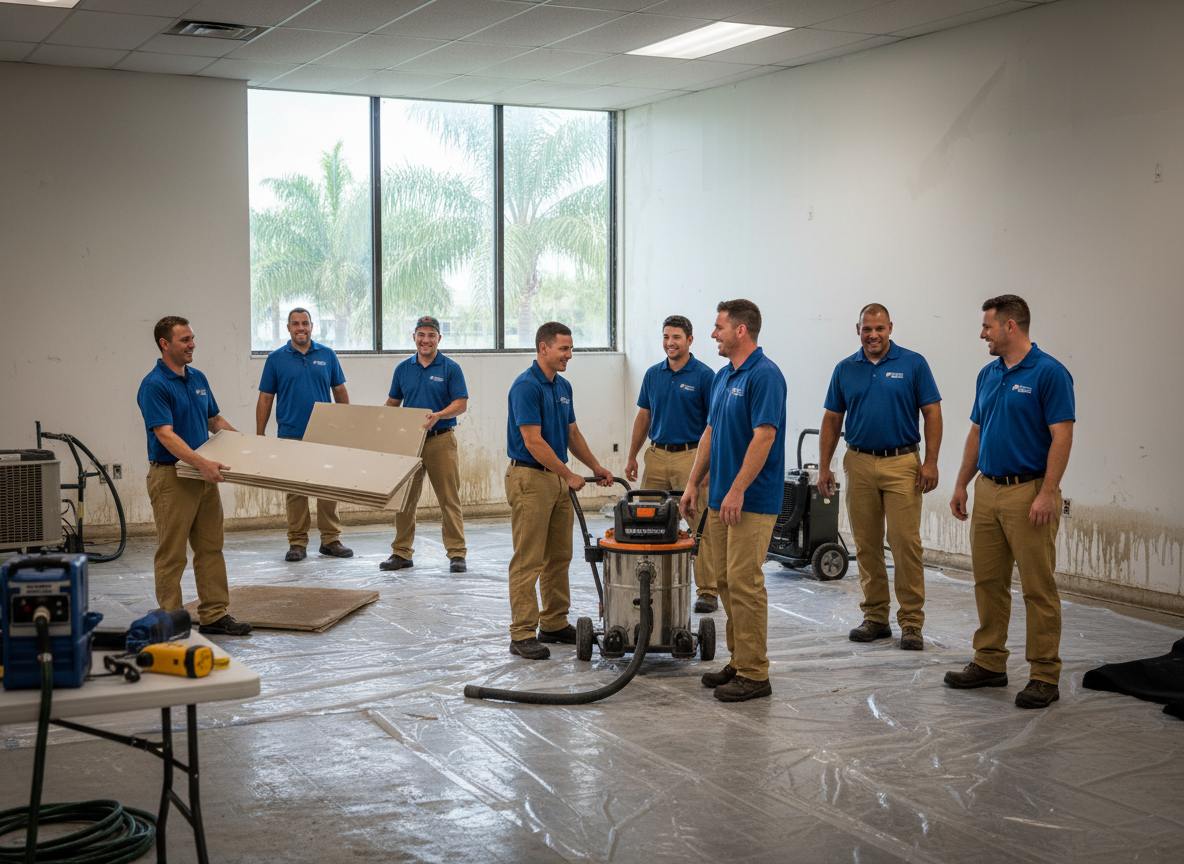
Loxahatchee Groves is a town of large lots, narrow canal-side roads and a drainage system older than most of its houses. When water gets into a home here, the question is often not only where it came from but whether the canal that carries it away is doing its job. This page explains what we look for at a Loxahatchee Groves address.
What is different about water damage in Loxahatchee Groves?
The town drains through its own canal grid, and that grid is the reason the area can be lived on at all. Loxahatchee Groves covers about 12.53 square miles, sits at roughly 20 feet above sea level, and depends on the Loxahatchee Groves Water Control District to move storm water through about 30 miles of canals. A house here is only as dry as the canal beside it.
The town incorporated on 1 November 2006 to protect its rural character, and it has kept the large-lot pattern that came before it. That means a water loss can involve a house, a barn, a workshop and a packing shed on the same parcel, with more than one water service and more than one place for a leak to hide.
What shapes water damage in Loxahatchee Groves?
Four local facts explain most of the water work here: the canal grid, the elevation and storm history, the rural building stock, and the way the town and the drainage district divide responsibility.
A canal grid dug more than a century ago
The larger canals in Loxahatchee Groves were dredged around 1917, when the West Palm Beach Canal opened the area to farming. The town's water control district now maintains about 30 miles of canals, most of them connected in a loop, with seven north-south canals feeding a collector that discharges into the C-51 canal through control structures. That is a working system, not a decorative one. When a culvert is blocked or a control structure is not passing water, the level in the canal rises and the ground beside it stays wet.
Twenty feet above sea level and a 1928 precedent
The town's elevation is about 20 feet, and the terrain is flat. In the 1928 Okeechobee hurricane, almost every home in Loxahatchee Groves was knocked off its foundations, a reminder of what a serious storm can do to a low, canal-drained community. Modern drainage is far better than it was then, but the underlying geometry has not changed: water has to be moved, and when the canals are full it has nowhere to go but into the lowest openings of a building.
Rural buildings, additions and outbuildings
Most Loxahatchee Groves properties are large-lot residential or agricultural parcels, and the buildings reflect that. A house may be original to the 1960s or 1970s with later additions, a barn may be newer than the house, and a workshop or a packing shed may have its own roof and its own water line. Additions are where a lot of water problems surface, because the junction between the old wall and the new opening is a place where rain, irrigation and roof runoff can enter.
Who serves the address
Loxahatchee Groves is an incorporated town, so building permits, plan review and code enforcement go through Town Hall on F Road. The Loxahatchee Groves Water Control District handles canals, drainage and many of the road rights-of-way. Fire rescue and law enforcement are provided by Palm Beach County. For a water job, the practical question is who owns the failed pipe or the blocked canal: a private line inside the lot, the district's canal, or a shared easement behind the properties. Maintenance is the part nobody sees. A blocked culvert, a collapsed bank or a control structure that is not passing water can raise the level beside a house without any rain falling on the roof, and the effect shows up as a damp wall base rather than a flood.
What does a Loxahatchee Groves property need from us?
A property here needs the building read and the drainage understood at the same time, because the two explain each other.
When water has entered from rain, a roof opening, a door track or a canal that rose, water damage restoration covers water removal, extraction, storm damage and leak detection. On a large lot, the wet boundary often runs further than the visible stain, because water moves sideways through sandy soil and under a sealed floor. We mark the boundary in the house and in any outbuilding that shares the water service, then dry against those readings.
When a wall, a ceiling or a barn room has stayed damp long enough to smell, mold damage restoration is the next service. Containment matters in a rural building because the work area may be next to feed, bedding or equipment, and because a barn's cavities are often connected to the loft and the outside air. We seal the work area, filter the air and remove what cannot be saved.
We also separate the building work from the drainage question. If the canal beside the property is not passing water, drying the house will not stop the next storm from repeating the problem, and we will say so rather than implying that a dehumidifier is a drainage solution.
Why use us in Loxahatchee Groves?
Because a canal-side property needs a scope that accounts for the canal as well as the wall. We work from 12841 Meadow Breeze Dr in Wellington, about two miles from Loxahatchee Groves, and we ask about the buildings, the shutoffs and the drainage before the visit. We name the trade that owns a plumbing, roofing, drainage or rebuild repair, and we put the readings and the scope in writing. We publish only the facts this business has supplied.
Why does a Loxahatchee Groves leak get worse quickly?
The climate and the ground both work against a wet building here. Relative humidity stays high for most of the year, the rainy season overlaps with hurricane season from June through November, and air conditioning keeps interior surfaces cool enough to condense moisture. A wall cavity that is damp in July is unlikely to dry in August, and growth can begin on a damp surface in about a day or two.
When the canals are high, the ground is saturated and water has nowhere to drain. That is the condition that turns a small leak into a recurring one: the wall base stays wet, the cabinet floor stays wet, and the same corner of the barn never dries out between storms. A property that has been through a wet season with an unresolved leak is a different scope from one that was caught in the first week.
Delay also changes what can be saved. Drywall paper, insulation, carpet pad, cabinet board and the bottom plate of a wall all take up water and hold it. The longer they stay wet, the more of them have to come out, and the more contents have to be moved and handled.
How does a job in Loxahatchee Groves run, step by step?
- Call and safety guidance. Tell us which buildings are wet, where the water came from and whether the canal beside the property is high. We tell you what to shut off and which areas to keep clear.
- Read the building and the lot. We read the house and any affected outbuilding, and look at how the lot drains toward the canal.
- Write the scope. The scope separates the building work from plumbing, roofing, drainage and rebuild work.
- Remove and extract. Standing water, saturated material and water held in timber or insulation come out.
- Dry against readings. Equipment runs at marked points until each building reaches a dry standard.
- Verify and hand back. Final readings are compared with day one, and the record names any other trade that owns a repair.
What's included in a Loxahatchee Groves job
- A moisture survey of the house and any affected outbuilding
- A check of the water service and shutoffs serving each building
- Extraction of standing water and removal of saturated material
- Containment and air filtration where growth is disturbed
- Drying equipment positioned against marked readings
- A written record of readings before and after
- A named hand-off for plumbing, roofing, drainage or rebuild work
Which nearby areas do we cover from Loxahatchee Groves?
Loxahatchee, The Acreage, Royal Palm Beach and Wellington are all within about ten miles of our Wellington base, and we cover each one. Loxahatchee and The Acreage share the large-lot, canal-drained pattern; Royal Palm Beach and Wellington are more densely built and drain through their own systems. Each has a separate page because the housing and the water pattern differ.
What should you do next?
Call (561) 960-0937 and tell us which buildings are wet, where the water first appeared and whether the canal beside the property is running high. If a ceiling is bulging or water is near a panel, keep the area clear. We cover Loxahatchee Groves from our base at 12841 Meadow Breeze Dr in Wellington. On a large-lot property, extraction is also a question of distance: a pump at the house may have to move water further than a hose can reach, and an outbuilding may need its own setup. We plan the equipment around the buildings that are actually wet rather than assuming one room.
We record the house and each outbuilding separately in the written scope, because a barn that stays damp after the house is dry is not a finished job.
Air conditioning adds a second source of moisture in a closed building, and a barn with no mechanical drying has only the outside air, which is often wetter than the timber.
In a town where the canals are the only outlet, that difference is often the difference between drying one room and removing a wall. The earlier the readings are taken, the more of the original building can stay. In a town where the canals are the only outlet, that difference is often the difference between drying one room and removing a wall. The earlier the readings are taken, the more of the original building can stay.
Around Loxahatchee Groves
We regularly work near:
- 📍Loxahatchee Groves Park
- 📍Southern Boulevard
- 📍Loxahatchee Groves Water Control District
Water Damage Restoration in Loxahatchee Groves — Local Notes
- •Incorporated 1 November 2006, ZIP 33470.
- •About 12.5 square miles and roughly 20 feet above sea level.
- •About 30 miles of canals, originally dredged around 1917.
- •Large-lot rural and agricultural parcels.