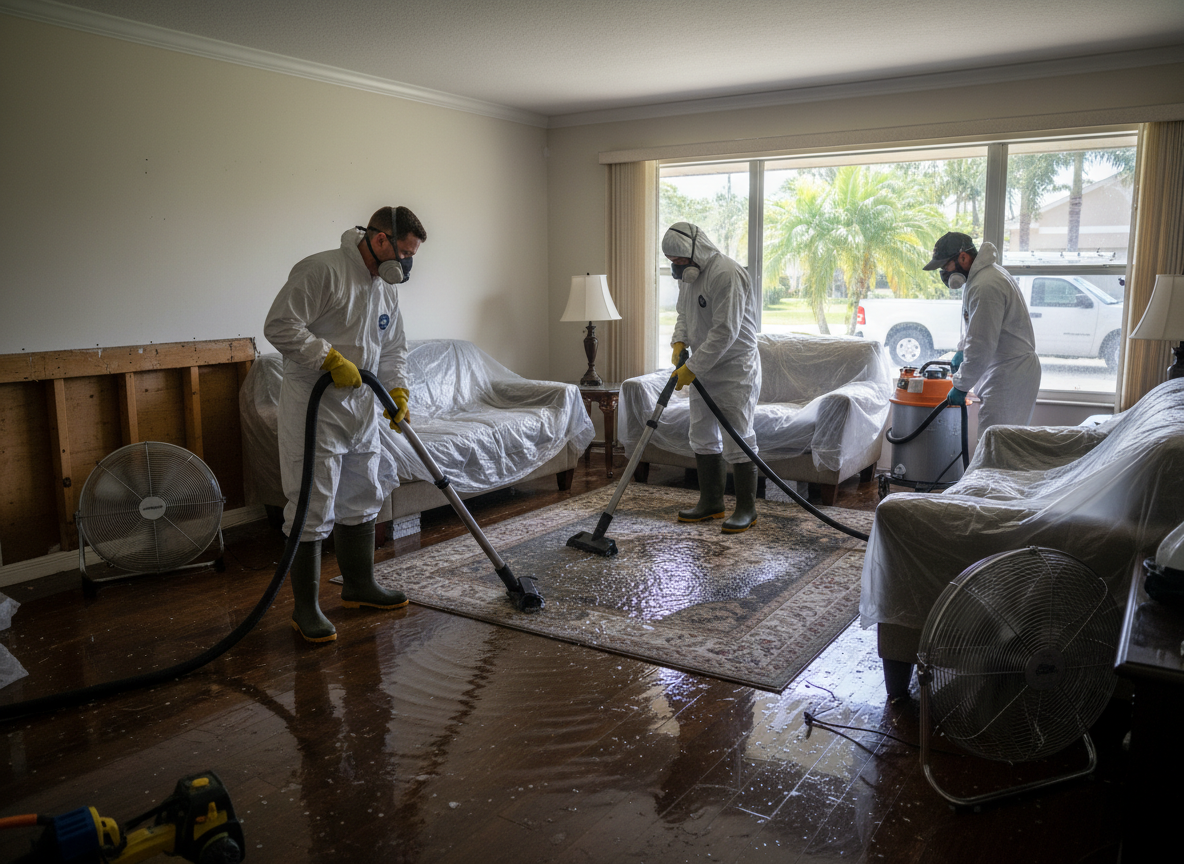
Water damage in Wellington rarely looks like the television version. There is usually no geyser and no lake in the living room. There is a soft baseboard behind a sofa, a dark line under a kitchen cabinet, a stain on the ceiling below an air handler, or a patch of carpet that feels cold underfoot three days after a storm. The water is there; it has simply found a place to sit where nobody walks barefoot.
What a water damage call in Wellington actually involves
A water damage job is a sequence of decisions, not a truck full of equipment. The first decision is where the water came from, because a failed supply line, a condensate overflow, a roof opening and canal water that backed into a garage are four different problems with four different scopes. The second is how far the moisture has travelled, which is rarely limited to the room where it showed. The third is what can be saved and what cannot, and the fourth is which repair belongs to another trade.
We work from 12841 Meadow Breeze Dr in Wellington, and we read the building before we propose removal. Meters and thermal imaging tell us where the wet boundary is, including inside a wall cavity, under a cabinet or below a tile floor. We mark those points by room and location and photograph them. The written scope that follows names what is being removed, what is being dried, and what sits outside our trade. That last part matters in a village where a lot of houses have been added to, renovated or rebuilt after a storm, because the assembly behind the finish is often not the one the original plans show.
We do not sell a package. A single bathroom with a clean supply-line leak is a different job from a barn wash rack that has been running for a week, and we scope them differently. What stays the same is the order: source, boundary, containment, removal, drying, verification, hand-off.
Why a Wellington leak gets worse faster than you expect
Wellington sits inland, but it is still South Florida. Relative humidity is high for most of the year, the rainy season overlaps with hurricane season from June through November, and air conditioning keeps interior surfaces cool enough to condense moisture out of the air. A wall cavity that is damp in July is not going to dry itself in August. Mold can begin on a damp surface in about a day or two, and a closed house with the system off can support it faster.
The ground makes it worse. Wellington is flat, and much of it was drained for farming before it was developed. The Acme Improvement District moves storm water through roughly 86 miles of canals, about 978 acres of lakes and eight pump stations, and that system is designed to hold water at a managed level rather than make every lot high and dry. In a heavy summer storm the canals rise, the ground saturates, and water takes the lowest path into a house: a garage slab, a door threshold, a lanai, a landscaping bed stacked against the wall.
Delay changes the scope. Water wicks into drywall paper, cabinet board, carpet pad, insulation and the bottom plate of a wall within hours. The longer it sits, the more material has to come out, and the more likely it is that the cavity has stayed damp long enough to support growth. Waiting for a dry week is not a plan in this climate, because the dry week may not arrive before the damage is set.
What we can show you, and what we will not claim
Mold Damage Restoration Wellington works from 12841 Meadow Breeze Dr, Wellington, FL 33414, in Palm Beach County. The phone number is (561) 960-0937, and it reaches the same business named in the footer of every page.
The services are two. Water damage restoration, this page, includes water removal, water extraction, storm damage and water leak detection. Mold damage restoration covers containment, removal of affected material and correction of the moisture source. The areas are Wellington and eight communities within about ten miles, all in Palm Beach County: Loxahatchee, Loxahatchee Groves, Royal Palm Beach, Golden Lakes, Lake Belvedere Estates, Royal Palm Estates, Greenacres and The Acreage.
We publish only the facts this business has supplied. We also do not claim that a job is cleared or passed by an authority we do not have. If your association or insurer requires an independent report, we will tell you what we can provide and what has to come from someone else.
The Wellington situation generic pages miss: a drained village with horses on the next lot
Most water damage pages describe a suburban house on a graded lot. Wellington is not that, or not only that. It is a village built on former farmland and strawberry fields, organised around a canal and lake system, with an equestrian economy that puts barns, paddocks and wash racks within a short drive of ordinary subdivisions. A single street can have a 1980s canal-lot house, a renovated estate with a guest apartment over the barn and a low-rise condo building on the other side.
That mix changes how water behaves. A canal-lot house may sit a few inches above the water the canal carries in a storm, and the soil behind the seawall stays wet long after the rain. A property with a barn often has more than one water service: the house meter and a separate line to the barn, wash racks, a feed room, a tack room and hose bibs at the paddocks. A leak under a wash rack can run for days because the floor is wet by design, and a feed room or tack room holds leather, feed and bedding that should never stay damp. When we assess a Wellington equestrian property, we ask which buildings are on which shutoff before we start.
The newer large houses bring their own pattern. A big air-conditioned volume produces a lot of condensate, and the air handler is often in a closet, a garage or a second-floor mechanical room where a slow overflow is invisible until it reaches a ceiling below. Add a pool pump, an irrigation system and a refrigerator ice line, and a modern Wellington house can have six or seven pressurised water connections that nobody looks at. The leak is usually at one of them, not at the roof.
Where the water comes from in a Wellington house
Four components account for most of the water work we are asked to scope here. Each is a building problem with a specific owner, and naming that owner is part of the job.
A failed supply line behind a cabinet
The component is the braided line, the shutoff valve and the fitting behind a sink, a vanity, a washing machine or a refrigerator. These fail slowly, and the cabinet floor holds the water against the wall base. What you notice is a dark stain on the cabinet floor, a soft toe kick, a smell when the doors are open, or paint lifting on the wall behind the vanity. The first move is to shut the valve, empty the cabinet and leave the doors open so the area can be read. The plumbing repair belongs to a plumber; the cabinet assessment, containment and drying are ours. In a Wellington house with a kitchen island or a laundry closet, the same failure can travel under the floor and show up a room away.
A water heater that rusts from the inside
The component is the tank, the pressure relief valve, the supply connections and the pan. A tank usually gives warning: moisture at the base, a metallic smell, a popping sound or a damp patch on the slab. In a garage or a closet, the water spreads across the floor and into the bottom plate of the wall before anyone sees a puddle, and the pan drain may be clogged or missing. The first move is to shut off the power or gas and the water supply if it is safe to do so. Replacing the heater is a plumbing job; drying the closet, the wall base and the adjoining room is ours.
An air-handler condensate overflow
The component is the air handler, the coil, the primary drain, the secondary pan and the float switch. Wellington systems run for most of the year, so the coil produces condensate every day. A drain line that clogs with algae, a pan that is not pitched or a float switch that has failed puts water on the platform and into the closet floor. What you notice is a musty smell at the supply registers, a rust ring on the platform, water on the closet floor or a stain on the ceiling below. The first move is to switch the system off and check the pan before it runs again. Clearing the drain is an HVAC repair; the damp closet, insulation and ceiling are ours to contain and dry.
A roof or window opening after a storm
The component is the roof covering, the flashing, the window frame, the track and the weep holes. Wind-driven rain enters where the track drains poorly, the flashing has failed or a shingle has lifted, and the water sits in the wall below the opening. What you notice is a soft sill, bubbling paint, a musty bedroom or a stain that appears only after a storm from a particular direction. The first move is to photograph the interior and exterior, clear the weep holes if they are blocked and keep the opening closed until it is repaired. The envelope repair belongs to a roofer or a window contractor; the wet assembly is ours.
The four parts of the service, each with its own steps
Water damage restoration is one service with four working parts. They are described separately because each has its own sequence and its own list of what is included.
Water removal
Water removal is the first response: getting standing water out of the building before it spreads into more material. It is not the same as extraction, because a pump and a wet vac can lift water off a floor without reaching the water held in carpet, pad or a cabinet base.
Steps
- Confirm the source is stopped, or isolate the area if it cannot be stopped yet.
- Identify the low points and the path the water is taking.
- Pump or extract standing water, working from the deepest point outward.
- Check the rooms the water travelled to, not only the room where it pooled.
What's included
- Standing-water removal with pumps and extraction equipment
- A check of adjoining rooms, closets and wall bases
- Photographs of the water line before it is removed
- A written note of where the water came from and where it went
Water extraction
Water extraction pulls water out of the materials that hold it: carpet, carpet pad, upholstery, cabinet bases and the cavities behind a wall. A household wet vac is not extraction in this sense. It can lift surface water, but it cannot dry a pad or a wall cavity, and it can spread contamination if the water is not clean.
Steps
- Identify the water category: clean supply-line water, grey water from an appliance, or contaminated surface water.
- Extract carpet and pad, and decide whether the pad can be saved.
- Remove water from cabinet bases, toe kicks and any accessible cavity.
- Set drying equipment and record the first readings.
What's included
- Carpet and pad extraction, with pad removal where it cannot be saved
- Cabinet-base and toe-kick extraction
- Accessible cavity drying
- First-round moisture readings marked by room and location
Storm damage
Storm damage is water that entered from outside during a weather event: at a roof, a window, a door, a lanai, a garage or a wall penetration. It is scoped differently from a supply-line leak because the water may have carried sediment or debris, and because the opening that let it in usually needs a repair before the next storm.
Steps
- Identify every opening the water used, not only the one that is obvious.
- Separate clean rain entry from surface water that carried sediment.
- Remove water and saturated material, and contain the work area where needed.
- Dry the assembly and name the envelope repair that belongs to another trade.
What's included
- A room-by-room check after wind-driven rain
- Extraction and removal of saturated material
- Containment and air filtration where debris or growth is present
- A written hand-off for roof, window or door repairs
Water leak detection
Leak detection is the part that finds the entry before a wall or floor is opened. It does not replace a plumber, and it does not confirm a failed pipe by itself. It narrows the search so the repair is targeted rather than exploratory.
Steps
- Read the wall bases, cabinet floors, ceilings and slab with meters and thermal imaging.
- Compare readings across rooms to find the direction the water is travelling.
- Identify the most likely component and the trade that owns it.
- Mark and photograph the area for the plumber or the next contractor.
What's included
- Moisture readings and thermal imaging of the affected assembly
- A marked boundary and photographs by room
- A named likely source and the trade that owns the repair
- A written record you can hand to a plumber or an insurer
How a water damage job runs, step by step
- Call and safety guidance. Describe what is wet, where it came from and whether water is still running. We tell you what to shut off and which rooms to keep clear.
- Read the building. We mark moisture points at wall bases, cabinet floors, ceilings and any concealed cavity we can reach, and confirm whether the source is still active.
- Write the scope. The scope names removal, drying, containment and any repair that belongs to a plumber, roofer, HVAC contractor or general contractor.
- Remove and extract. Standing water comes out first, then saturated material, then water held in finishes.
- Dry against readings. Air movers and dehumidifiers run at the marked points until the assembly reaches a dry standard.
- Verify and hand back. Final readings are compared with day one, room by room, and you receive the record of what was found, removed and read.
What's included in water damage restoration
- A moisture assessment before any removal is proposed
- Water removal and extraction, with saturated material removed where it cannot be saved
- Containment and air filtration where growth or contaminated water is involved
- Drying equipment positioned against marked readings
- Photographs and a moisture map by room
- A named hand-off for plumbing, roofing, HVAC or rebuild work
What is not included
- Plumbing repairs, roof repairs or HVAC repairs
- Reconstruction of removed drywall, cabinetry, flooring or trim
- Independent clearance testing or laboratory analysis
- Work on common elements that an association controls, without the association's approval
Questions Wellington homeowners ask
How quickly should water be removed? The sooner standing water is out, the less material takes it up. Water wicks into drywall paper, cabinet board, carpet pad and the bottom plate of a wall within hours, and the humidity inside the house rises as it evaporates. The first hour is mostly about stopping the source and keeping people safe; the first day is about getting the water out and the readings taken.
Can you find a leak without opening the wall? We can narrow it with meters and thermal imaging and show where the moisture is concentrated. Confirming the failed component is a plumbing or leak-detection task, and the repair belongs to a plumber. We document the readings so the repair is targeted rather than exploratory.
Do you remove the drywall? Only where the material cannot be saved or the cavity has to be opened to dry it. The readings and the water category decide it, and the scope names it before removal starts. A clean supply-line leak in a wall that can be dried in place is a different job from canal water that soaked the bottom plate.
My house is on a canal. Is that water treated differently? Yes. Canal water is surface water and can carry sediment, lawn chemicals and whatever else the canal has picked up, so material that took it is usually assessed as contaminated and removed rather than dried in place. Rain that enters at a door track is usually a clean-water loss, which gives more options for saving material.
What about a barn, tack room or guest apartment? Those are separate buildings with their own lines and shutoffs, and they need to be read separately. Leather, feed and bedding hold moisture and odour, and a wash rack can hide a supply-line leak because the floor is wet anyway. Tell us which buildings are on which shutoff when you call.
Will my insurance cover the work? That depends on your policy and on the cause, and we do not speak for your insurer. What we can do is document the loss: the readings, the photographs, the material removed and a moisture map by room. Sudden plumbing failures and storm entry are usually treated differently from long-term seepage, so the record matters.
What to do next
Call (561) 960-0937 and describe where the water is, what it came from and when you first noticed it. If a ceiling is bulging, move what is underneath it and keep the room clear. If the water is near outlets, a panel or an appliance, do not walk through it. We work from 12841 Meadow Breeze Dr in Wellington and cover the village plus eight Palm Beach County communities within about ten miles.
Water Damage Restoration Services We Offer
✓Water Removal
Standing water pumped and extracted before it reaches more material.
✓Water Extraction
Water pulled from carpet, pad, cabinet bases and concealed cavities.
✓Storm Damage
Water that entered at roofs, windows, doors and lanais during a storm.
✓Water Leak Detection
The entry point found before a wall or floor is opened.
How it works
- 1
Call and safety guidance
Describe the source and the rooms affected so we can tell you what to shut off.
- 2
Read and scope
Moisture readings, thermal imaging and a written scope before removal.
- 3
Remove and extract
Standing water, saturated material and water held in finishes come out.
- 4
Dry against readings
Equipment runs until the assembly reaches a dry standard.
- 5
Verify and hand back
Final readings compared with day one, with any other trade named.