2026-10-19T08:32:53.702Z ·
Why Wellington Homes Stay Damp After the Rain Stops
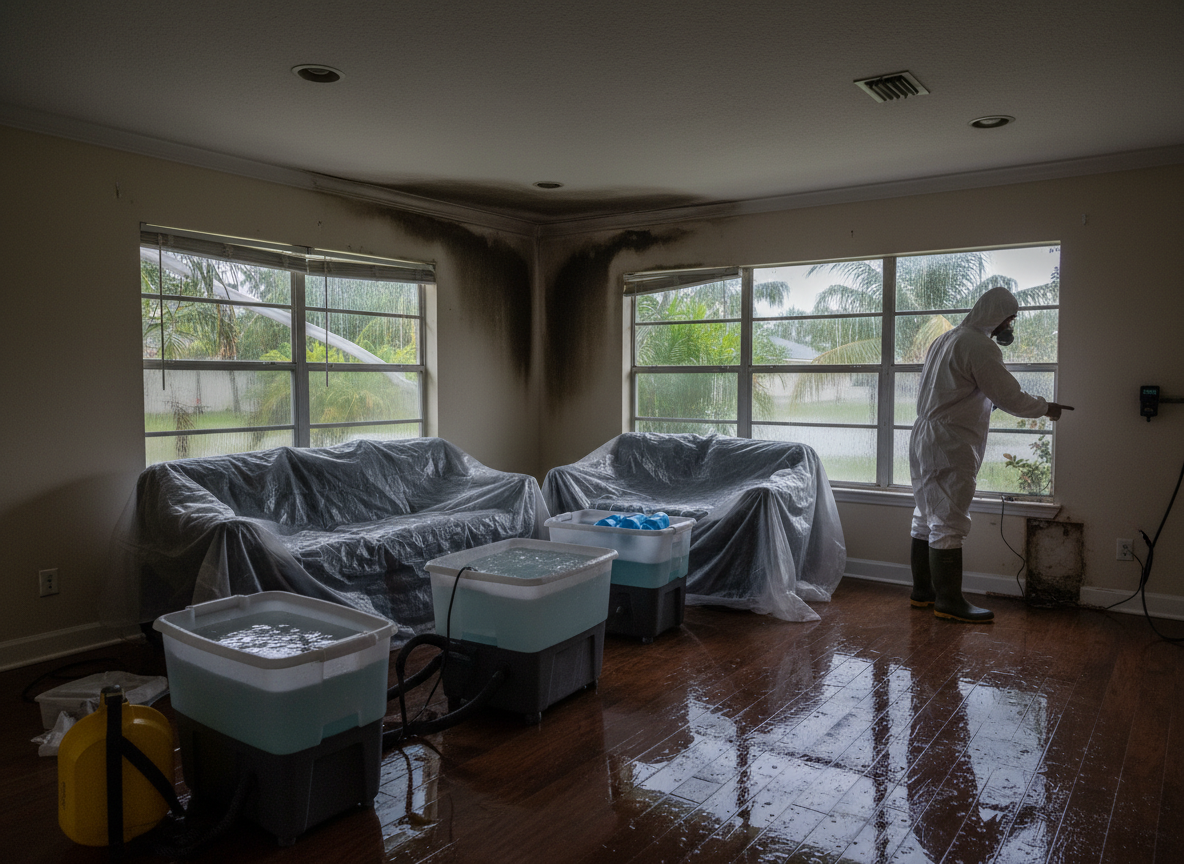
The rain stops, the standing water in the street drains away, and by the next afternoon the pavement looks dry. Inside a Wellington house, the story can be going the other way. Water that entered at a door track, a lanai, a roof penetration or a wall base is now inside the assembly, and the warm, humid air is keeping it there.
Wellington is a drained landscape, and the drainage is the point
Wellington was assembled from land that used to flood. Charles Oliver Wellington bought roughly 18,000 acres in 1951, and the state created the Acme Drainage District in 1953 to drain it for agriculture. The result was farmland, then a planned village, and today the district maintains roughly 86 miles of canals, about 978 acres of lakes and eight pump stations. That system is why the village works. It is also why a house here sits on ground that is designed to hold and move water, with a water table that stays close to the surface.
When a summer storm drops several inches in an afternoon, the canals rise, the lakes fill and the ground is saturated. Water takes the shortest path into anything lower than the surrounding grade: a garage slab, a door threshold, a lanai that was built a few inches below the house, a landscaping bed piled against the wall. Once it is in, the air conditioning keeps the interior cool, and cool surfaces condense moisture out of air that is already heavy.
The four places a Wellington house stays wet
Most of the post-storm moisture we are asked to read is in one of four places.
The air-handler closet. Wellington systems run for most of the year, so the coil produces condensate every day. A primary drain that clogs with algae, a float switch that has failed or a secondary pan that is not pitched correctly puts water on the platform and into the closet floor. The smell shows up at the supply registers before the stain shows up on the ceiling below.
Behind a cabinet or vanity. Braided supply lines and shutoff valves fail slowly. The cabinet floor holds the water against the wall base, and the toe kick hides it. A dark line on the cabinet floor, a soft toe kick or paint lifting behind the vanity is the tell.
The water heater closet or garage. A tank that rusts through usually gives some warning: moisture at the base, a metallic smell, a pop or a damp patch on the slab. In a garage, the water spreads across the slab and into the bottom plate of the wall before anyone sees a puddle.
A window or door track after wind-driven rain. The track fills, the weep holes are blocked or the flashing above the opening has failed, and water sits in the wall below the sill. It often appears only after a storm from a particular direction, which makes it easy to dismiss as a one-off.
Why a dry surface is not a dry wall
Tile over a slab can feel dry while the slab and the bottom plate stay wet. A painted wall can look and feel dry on the room side while the paper on the back of the drywall is damp. Carpet can be dry on top and soaked in the pad. This is why a hand is not a moisture reading, and why the useful question is not "does it feel wet" but "where is the wet boundary and is it moving".
A meter read at the wall base, the cabinet floor and the ceiling below the air handler gives you a number you can compare a few days later. Without that comparison, a house can be closed up with the air conditioning running and a cavity still holding water, which is the condition mold needs.
Horse properties have a second plumbing system
A Wellington equestrian property is not one building. There is the house, and then there is the barn: wash racks, feed rooms, tack rooms, a hay loft, a guest apartment, maybe an outdoor shower and a hose bib at every paddock. Each of those has a supply line and a shutoff, and some of them are on a separate service.
Water in a feed room or a tack room is a different problem from water in a hallway. Leather, feed and bedding hold moisture and odor, and a small leak under a wash rack can run for days because the floor is wet anyway. If a barn has its own meter, knowing where that shutoff is saves time.
What to do in the first 48 hours
Stop the water at the fixture or the main shutoff if it is safe to reach. Keep people out of rooms with standing water, wet ceilings or water near outlets and panels. Do not run a household vacuum in standing water. Photograph the room, the water line and the source before you move anything, and move only what is easy to move and dry.
Then call (561) 960-0937 and describe what is wet, where it came from and when. A clean supply-line leak and canal water that backed into a garage need different scopes, even when the same room is wet. The sooner the source is confirmed and the readings are taken, the more material can be saved.